Plant
Aloe vera
Aloe vera
Also known as: Aloe barbadensis, true aloe
A succulent perennial in the family Asphodelaceae — native to the southern Arabian Peninsula, but cultivated and naturalized globally for thousands of years. The clear gel inside the leaves is one of the most universally-recognized traditional medicinal plant preparations — used topically for burns and skin conditions across virtually every traditional pharmacopoeia from ancient Egyptian to Ayurvedic to Traditional Chinese Medicine to the modern global cosmetics industry.
Scientific
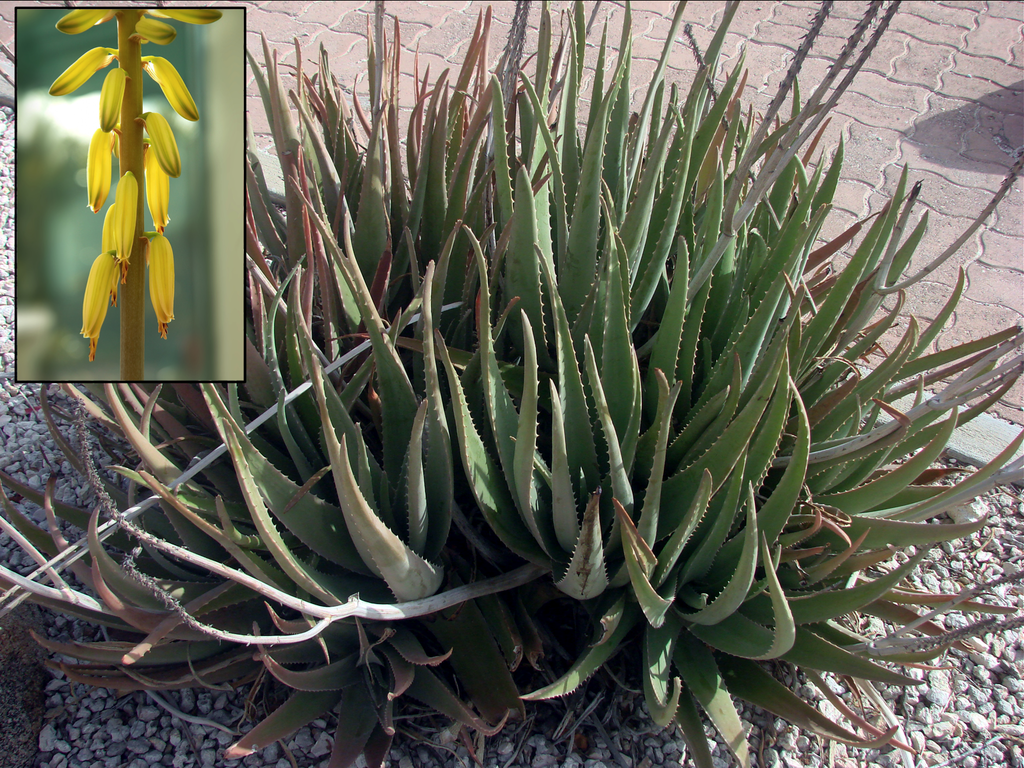
Aloe vera (family Asphodelaceae) is a stemless or short-stemmed succulent with thick fleshy leaves arranged in a rosette. Origin in the southern Arabian Peninsula (Oman, Yemen); the species has been cultivated outside its native range for so long that wild vs. naturalized populations are difficult to distinguish.
The leaf contains two distinct substances:
- Inner gel — clear, mucilaginous, ~99% water with polysaccharides (especially acemannan); the part used topically and increasingly in commercial aloe drinks and supplements
- Outer latex — yellow, bitter, contains anthraquinones (aloin); historically used as a laxative but now widely restricted due to safety concerns
Cultural and historical
Aloe vera appears in some of the earliest documented medicinal texts. The Ebers [[papyrus|Papyrus]] (~1550 BCE Egypt) describes aloe preparations for skin conditions and wound healing. Dioscorides’s De Materia Medica (~70 CE) describes the species in detail. Cleopatra is said to have used aloe gel as a beauty treatment.
The species spread along Arab trade routes across the medieval Islamic world, into the Mediterranean, and via Spanish colonization to the Caribbean and the Americas. In every region of arrival, it was rapidly adopted into local traditional medicine.
Modern uses
Aloe vera is one of the most-extracted plants in the modern cosmetics and supplements industry. Topical use for burns, sunburn, and minor wounds is the most extensively studied application — meta-analyses suggest modest efficacy for first- and second-degree burns and for managing radiation-therapy skin damage. Internal-use claims are far less well-supported and in some cases (the latex/anthraquinone fraction) actively harmful.
Global production
Top producers: Mexico, Dominican Republic, USA, China, India.
See also
Auto-generated from this entry’s typed relations: frontmatter, grouped by relation type so the editorial signal isn’t flattened.
- Shares approach with: [[pelargonium-sidoides]] · [[artemisia-afra]] · [[yarrow]] · [[witch-hazel]] · [[wild-bergamot]] · [[valerian]]
- Member of: [[plants]]
Sources
- Wikipedia — Aloe vera
A plant entry in the 0mn1.one [[directory]].
What links here, and how
Inbound connections from across the wiki, grouped by lens and by relationship. These appear automatically — every entity page declares what it links to, and that data populates here on the targets.
Cultural
shares approach with
- Boston fern auto-linked from body mention
- Jade plant Beginner-succulent kin — jade plant and aloe vera are the two most-recommended starter succulents in Western houseplant tradition; both nearly impossible to kill, both propagate trivially from cuttings or leaves.
General
shares approach with
- Frankincense auto-linked via shared tag: arabian-peninsula
- Myrrh auto-linked via shared tag: arabian-peninsula
4 inbound links · 7 outbound