Plant
Sweet potato
Ipomoea batatas
Also known as: Ipomoea batatas, kumara
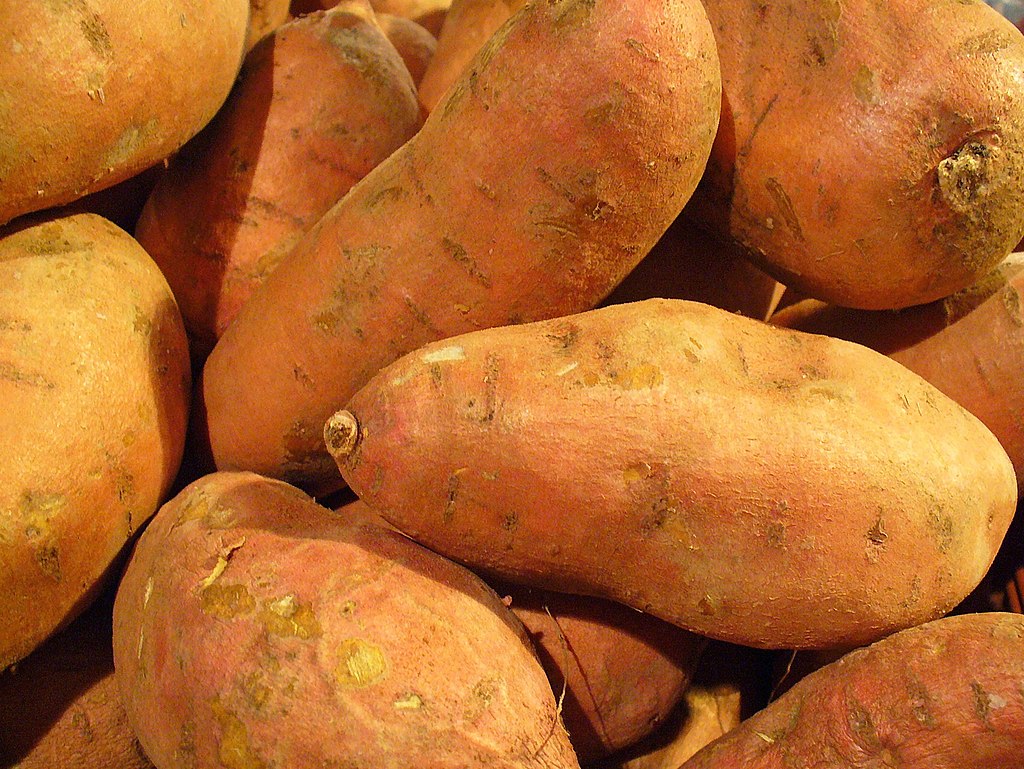
A trailing herbaceous perennial in the morning-glory family (Convolvulaceae), grown for its starchy, sweet-fleshed storage roots. Domesticated in tropical Central or South America at least 5,000 years ago; reached Polynesia (where it is called kūmara) in pre-Columbian times — one of the few firmly-documented pre-1492 crop exchanges across the Pacific. Today one of the world's most productive staple crops per acre, central to the food economies of much of sub-Saharan Africa, East Asia, and the Pacific.
Scientific
Ipomoea batatas is in Convolvulaceae and is not botanically related to the common potato (Solanum tuberosum, Solanaceae) despite the shared common name. The edible part is a true root (a thickened lateral root), distinct from the potato’s tuber (a swollen stem).
The orange-fleshed cultivars are exceptionally rich in beta-carotene; biofortified orange sweet potato cultivars are central to vitamin-A-deficiency public health programs across sub-Saharan Africa.
Cultural and historical
The pre-Columbian Polynesian presence of sweet potato is one of the most discussed puzzles in human-migration history. Genetic and linguistic evidence (the word kūmara in Polynesian languages traces to kumar in coastal Andean Quechua) supports human-mediated transfer across the Pacific by 1000 CE — likely via Polynesian voyaging. The crop became central to Māori agriculture in Aotearoa, where it remains culturally significant.
In China and East Africa the sweet potato is a daily staple; in the American South it became culturally embedded through enslaved-African foodways and remains a holiday-meal anchor.
Global production
Top producers: China (by a wide margin), Malawi, Tanzania, Nigeria, Uganda. Yields per acre exceed those of most cereal crops, making it one of the most calorie-dense staples for smallholder agriculture.
See also
Auto-generated from this entry’s typed relations: frontmatter, grouped by relation type so the editorial signal isn’t flattened.
- Shares approach with: yam · potato · wheat · tomato · tea
- Member of: plants
- Cousin of: morning-glory
Sources
- FAO Crop Statistics
- International Potato Center (CIP) sweet potato program
- Wikipedia — Sweet potato
A plant entry in the 0mn1.one directory.
What links here, and how
Inbound connections from across the wiki, grouped by lens and by relationship. These appear automatically — every entity page declares what it links to, and that data populates here on the targets.
Scientific
cousin of
- Morning glory auto-linked from body mention
Cultural
shares approach with
- Peanut American Southern smallholder kin — sweet potato and peanut were the two crops Carver focused on at Tuskegee as Black-farmer alternatives to cotton dependency; together they form the agronomic core of the Southern Black-farming inheritance.
General
shares approach with
- Potato auto-linked via shared tag: domesticated
- Strawberry auto-linked via shared tag: americas
- Yam auto-linked via shared tag: americas
5 inbound links · 7 outbound