Plant
Potato
Solanum tuberosum
Also known as: Solanum tuberosum
A starchy tuber from the nightshade family (Solanaceae), domesticated in the Andean highlands of present-day Peru and Bolivia around 8,000 years ago. The world's third-largest food crop by mass after rice and wheat, and the largest non-cereal food crop. Its post-Columbian spread into Eurasia is one of the few historical events that's plausibly visible in continental population data — the calories the potato added to Northern European diets are credited with a measurable share of the 1700s population boom.
Scientific
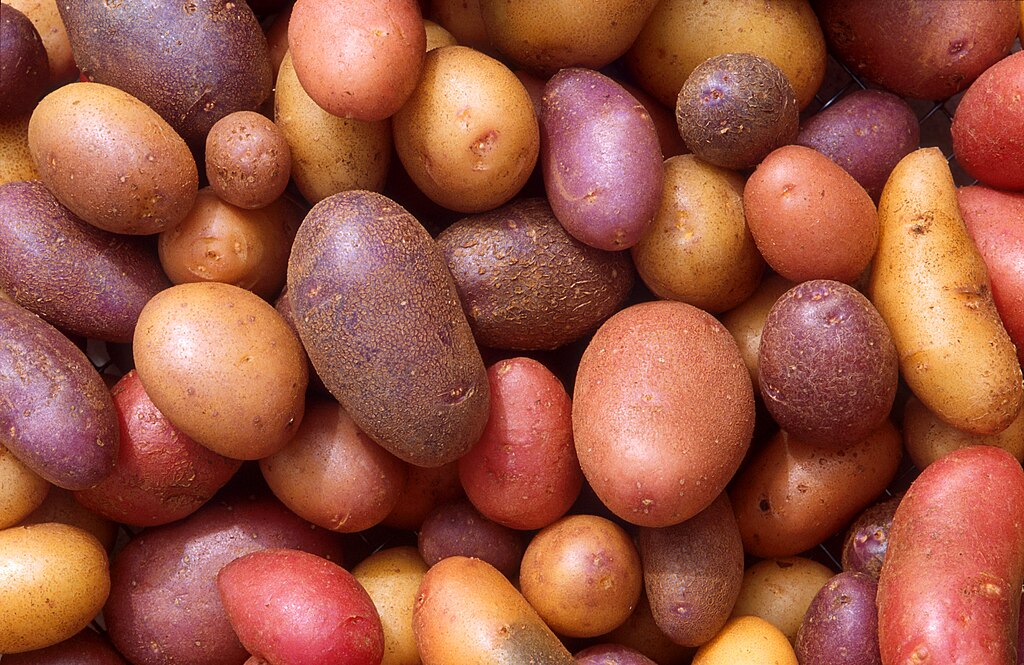
Solanum tuberosum is a herbaceous perennial grown as an annual for its underground stem tubers. The Andes still harbor the species’ genetic diversity — thousands of indigenous landraces are cultivated in Andean farming communities, often at multiple elevations, with varieties selected for cold tolerance, frost resistance, drought, and disease.
The potato’s leaves and fruit are toxic (solanine alkaloids); only the tuber is edible. Green-tinged tubers indicate solanine buildup and should be avoided.
Cultural and historical
Andean civilizations developed the potato into a staple ~8,000 years ago, eventually producing the freeze-dried chuño storage form that supported high-altitude empires (Tiwanaku, the Inca) where most crops would not grow. The Inca empire is unimaginable without the potato.
European introduction (16th–17th centuries) was slow at first — the plant was suspect for not appearing in scripture, and its nightshade family made it look poisonous. By the 18th century the potato had become a primary calorie source across Ireland, the Low Countries, Germany, and Eastern Europe. The Irish Potato Famine (1845–1852), triggered by Phytophthora infestans, killed roughly a million people and pushed another million into emigration — partly a story about late blight, mostly a story about colonial dependency and British grain export policy.
Global production
Top producers: China, India, Russia, Ukraine, USA.
See also
Auto-generated from this entry’s typed relations: frontmatter, grouped by relation type so the editorial signal isn’t flattened.
- Shares approach with: sweet-potato · pepper · common-bean · yam
- Member of: plants
- Cousin of: tomato · eggplant
- Grown by: baar-potato-farm · gallops-sweet-potatoes · reddi-cut-potatoes
- Produced by: gramya-sikshan-paryavaran-sanstha
Sources
- International Potato Center (CIP) species materials
- Wikipedia — Potato
A plant entry in the 0mn1.one directory.
Grown by
All listings →Farms and nurseries in the 0mn1.one directory that grow potato. Each is a real working operation — visit, buy from, learn from.
Baar Potato Farm
circulatordownstate-illinois
Baar Potato Farm — a farm verified in OpenStreetMap. See [[farm]] for the directory's editorial position; this entry may also operate retail surfaces (farm stand, CSA, farmers-market) that should be added as separate relations.
Gallop's Sweet Potatoes
circulatorGallop's Sweet Potatoes — a farm verified in OpenStreetMap. See [[farm]] for the directory's editorial position; this entry may also operate retail surfaces (farm stand, CSA, farmers-market) that should be added as separate relations.
Reddi Cut Potatoes
circulatorblackland-prairies
Reddi Cut Potatoes — a farm verified in OpenStreetMap. See [[farm]] for the directory's editorial position; this entry may also operate retail surfaces (farm stand, CSA, farmers-market) that should be added as separate relations.
What links here, and how
Inbound connections from across the wiki, grouped by lens and by relationship. These appear automatically — every entity page declares what it links to, and that data populates here on the targets.
Scientific
grows
- Baar Potato Farm name token matches /\bpotato(?:e?s)?\b/
- Gallop's Sweet Potatoes name token matches /\bpotato(?:e?s)?\b/
- Reddi Cut Potatoes name token matches /\bpotato(?:e?s)?\b/
substrate of
- Central Andes the central Andes are the potato's center of origin and remain the world's deepest reservoir of potato genetic diversity
Practical
demonstrated by
- Chuño chuño is the principal preservation technology applied to the Andean potato; without it, high-altitude Andean civilization could not have stored its principal calorie source
produces
- Gramya Sikshan Paryavaran Sanstha NPOP scope: major crop certified
demonstrates
- Quechua Quechua farmers maintain the ~4,000 traditional potato cultivars and the world's deepest potato genetic diversity in their living fields
Cultural
shares approach with
- Chestnut auto-linked from body mention
- Leek auto-linked from body mention
- Pepper (Capsicum) auto-linked from body mention
- Petunia auto-linked from body mention
Historical
demonstrated by
- Columbian exchange potato traveled from the Andes to Europe in the late 1500s and became one of the two great staples of 18th-19th-century European peasant agriculture (alongside maize)
General
shares approach with
- Sweet potato auto-linked via shared tag: domesticated
- Yam auto-linked via shared tag: staple-crop
16 inbound links · 7 outbound