Plant
Salak
Salacca zalacca
Also known as: Salacca zalacca, snake fruit
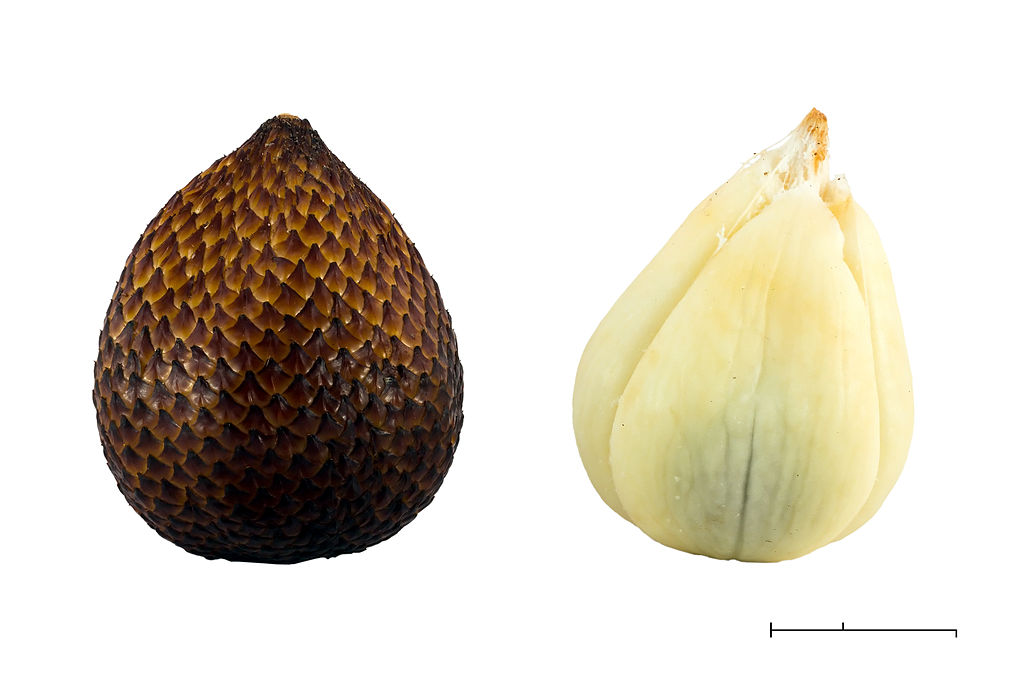
A short stemless palm native to maritime Southeast Asia — Indonesia, Malaysia, the Philippines. The fruit has a distinctive reddish-brown reptilian-scaled skin (the source of the English common name 'snake fruit') and crisp white segmented flesh inside. The flavor is sweet-acid, often described as a combination of apple, pineapple, and banana with a slight astringent edge. Foundational to Indonesian street-market fruit culture; widely sold across Southeast Asia and increasingly available globally.
Scientific
Salacca zalacca is in Arecaceae (the palm family). Unlike the towering coconut and date palms, salak grows as a low stemless clump-forming palm with feathery fronds emerging from a basal rosette. The trunk is short or absent; the plant looks more like a giant cycad-like cluster than a typical palm.
The fruit grows in clusters at the base of the plant. Each fruit is fig-sized, with a tightly-fitting scaly red-brown skin that peels off (carefully — the spines on the parent palm can puncture skin during harvest) to reveal 1–3 segments of pale waxy-textured flesh, each containing a large inedible brown seed.
Two principal cultivar groups:
- Salak pondoh — Indonesian, especially Yogyakarta region; sweet and prized
- Salak bali — Balinese; slightly more astringent
Cultural and culinary
Indonesian and Malaysian fruit-market culture treats salak as one of the regional fruits — sold in the same context as mangosteen, rambutan, durian, lychee. The species’ visual distinctness — the scaly skin really does resemble snake or reptile skin — makes it a memorable specimen for foreign visitors.
Standard preparations:
- Eaten fresh (the most common)
- Manisan salak — Indonesian candied salak preserves
- Asinan salak — pickled in salt brine; an Indonesian street snack
- Salak wine and salak liqueurs — small artisanal production in Bali
Global production
Top producers: Indonesia (overwhelming majority), Malaysia, Thailand, Brunei.
See also
Auto-generated from this entry’s typed relations: frontmatter, grouped by relation type so the editorial signal isn’t flattened.
- Shares approach with: mangosteen · rambutan · durian · lychee
- Member of: plants
Sources
- Wikipedia — Salak
A plant entry in the 0mn1.one directory.
What links here, and how
Inbound connections from across the wiki, grouped by lens and by relationship. These appear automatically — every entity page declares what it links to, and that data populates here on the targets.
4 inbound links · 5 outbound