Plant
Sacred lotus
Nelumbo nucifera
Also known as: Nelumbo nucifera, Indian lotus, Egyptian bean
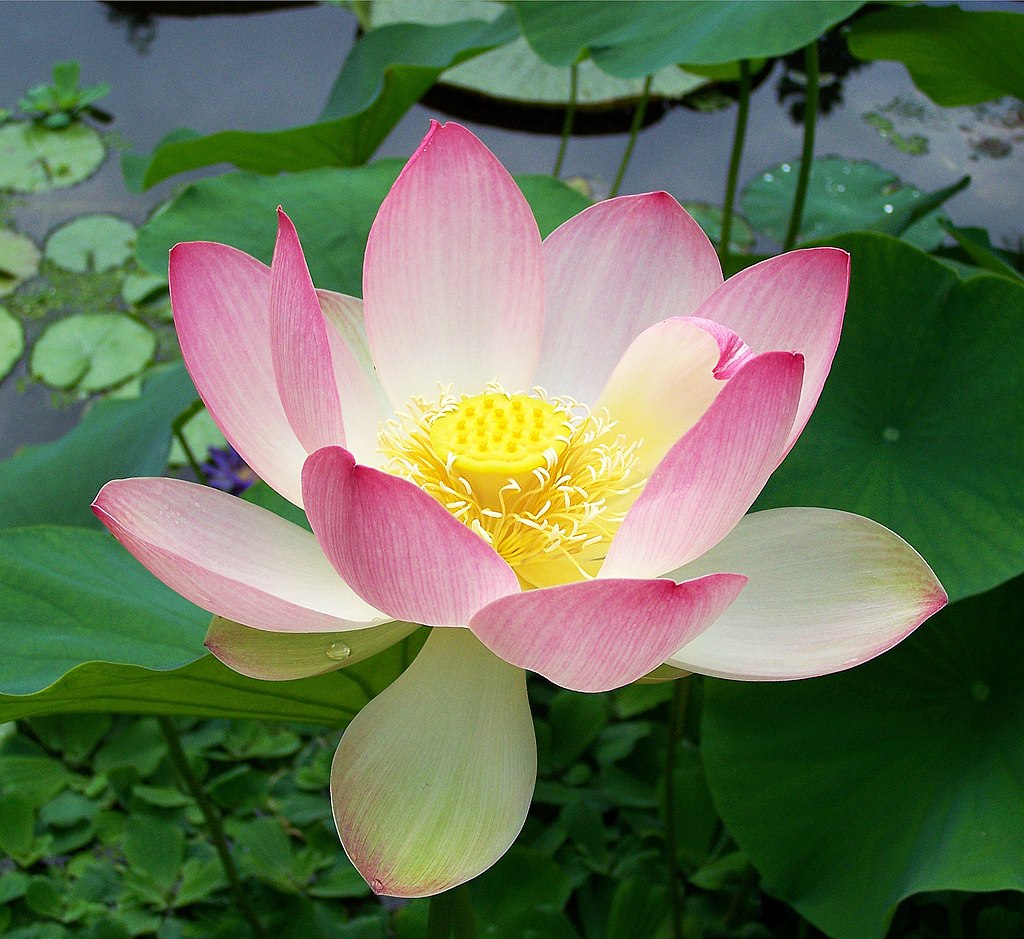
An aquatic perennial in the family Nelumbonaceae — the iconic lotus flower of Buddhist, Hindu, Jain, and ancient Egyptian iconography. The plant grows in muddy water but produces flowers and leaves that water cannot wet (the 'lotus effect' is a famous case of nanoscale self-cleaning surface chemistry). Native to a broad swath of Asia and northern Australia. The seeds are remarkable for longevity — viable lotus seeds 1,300 years old have been germinated.
Scientific
Nelumbo nucifera (family Nelumbonaceae — its closest living relative is Nelumbo lutea, the American lotus; the family has only two species). The plant grows in shallow water, with rhizomes anchored in muddy substrate and leaves and flowers held above the water surface on tall stems.
The leaves are superhydrophobic — water beads up and rolls off, carrying dirt particles with it. The microscopic-scale waxy bumps on the leaf surface that produce this effect are now the inspiration for entire industries of self-cleaning glass, paint, and fabric coatings — the “lotus effect” of materials science.
Lotus seeds are among the longest-lived viable seeds known. A seed recovered from a Chinese lake bed in the 1990s and radiocarbon-dated to ~1,300 years old was successfully germinated.
Cultural and religious
The lotus is one of the most cross-culturally significant plants in human iconography:
- Buddhism — the Buddha is depicted seated on a lotus throne; the flower’s emergence from muddy water represents the path of spiritual awakening from worldly suffering
- Hinduism — Vishnu’s navel produces the lotus from which Brahma is born; Lakshmi sits on a lotus; the padma mudra and lotus symbol pervade temple architecture
- Jainism — the tirthankara are often shown with lotus thrones
- Ancient Egypt — the blue lotus (Nymphaea caerulea, technically a different species but iconographically continuous) was central to Egyptian religious art; the lotus opens at dawn and closes at dusk, becoming a solar-rebirth symbol
- Chinese culture — the He lotus is the flower of the eighth lunar month; embodied in countless poems and paintings
The plant is edible — the rhizome (lotus root), seeds, and stamens are all used in East Asian cuisine.
See also
Auto-generated from this entry’s typed relations: frontmatter, grouped by relation type so the editorial signal isn’t flattened.
- Shares approach with: bodhi-tree · water-lily · pomegranate · papyrus · magnolia · lily
- Member of: plants
Sources
- Wikipedia — Nelumbo nucifera
- Shen-Miller et al., “Exceptional seed longevity and robust growth: ancient sacred lotus from China” (American Journal of Botany, 1995)
A plant entry in the 0mn1.one directory.
What links here, and how
Inbound connections from across the wiki, grouped by lens and by relationship. These appear automatically — every entity page declares what it links to, and that data populates here on the targets.
Scientific
counterpart to
- Water lily The classic taxonomic confusion — both called 'lotus,' both aquatic, both sacred in their cultures, but botanically unrelated (Nymphaeaceae vs Nelumbonaceae). Water-lily pads sit ON the water; lotus leaves are held ABOVE it.
Cultural
shares approach with
- Jujube auto-linked from body mention
- Pomegranate Cross-cultural fertility-and-abundance symbol kin — pomegranate fills this role across Mediterranean/Persian/biblical traditions, lotus across South and East Asian traditions.
- Pothos auto-linked from body mention
- Saguaro Cross-cultural sacred-plant kin — saguaro centers the Tohono O'odham religious calendar the way the sacred lotus centers Hindu/Buddhist iconography; long-cycle plant time in religious life.
General
shares approach with
- Jasmine auto-linked via shared tag: asia
- Lily auto-linked via shared tag: ancient-cultivar
- Magnolia auto-linked via shared tag: asia
- Papyrus auto-linked via shared tag: aquatic
- Water hyacinth auto-linked via shared tag: aquatic
10 inbound links · 7 outbound