Plant
Cotton
Gossypium (genus)
Also known as: Gossypium, Gossypium hirsutum
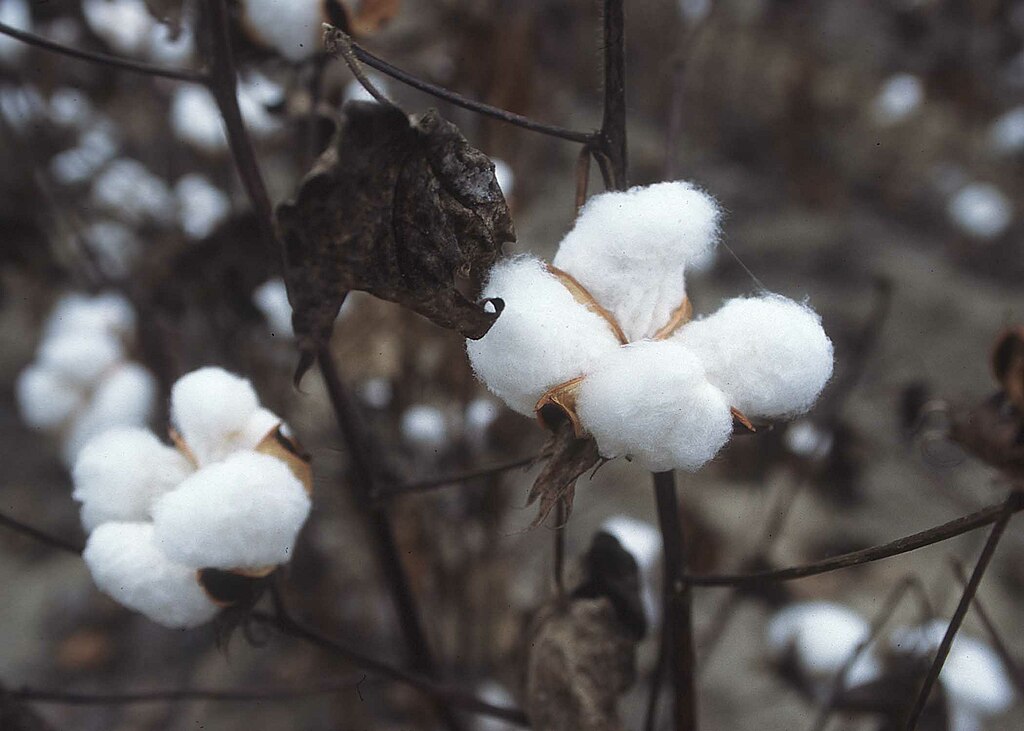
A genus of shrubs and small trees in the mallow family, independently domesticated four separate times — twice in the Old World (Africa/Arabia, India) and twice in the New World (Mesoamerica, coastal Peru). The fiber-bearing seed-floss of cotton is the most important non-food agricultural crop in the world; the modern industrial textile economy was built on this plant. The mechanization of cotton processing (gin, spinning jenny, power loom) is a substantial part of what we call the Industrial Revolution.
Scientific
Four cotton species were independently domesticated:
- Gossypium hirsutum — upland cotton, Mesoamerica; now ~90% of world cotton
- Gossypium barbadense — Egyptian / Pima / Sea Island cotton, coastal South America; long, fine staple
- Gossypium arboreum — tree cotton, India / Pakistan
- Gossypium herbaceum — African / Arabian cotton
The fiber is technically a seed hair — single-celled extensions of the seed coat. Each cotton boll contains 30+ seeds, each surrounded by thousands of these fiber cells.
Historical
Cotton was woven into cloth in the Indus Valley civilization (Mohenjo-daro, ~5,000 BCE) and along the coast of Peru at similar antiquity. The plant’s independent domestication on multiple continents reflects how broadly useful the fiber was.
The 18th–19th century industrial cotton economy is one of the most ecologically and morally consequential agricultural transformations in human history. The British textile industry’s demand for raw cotton drove the expansion of slave-worked cotton plantations across the American South; the 1793 cotton gin (Eli Whitney) was a force multiplier for that system. The Atlantic slave trade in its final and most intense decades was largely a cotton-supply system.
Modern production
Top producers: China, India, USA, Brazil, Pakistan. Cotton is among the most pesticide-intensive crops in conventional agriculture — accounting for ~16% of global insecticide use on ~2.5% of arable land. Organic cotton, Better Cotton Initiative cotton, and Fair Trade cotton certifications exist to address the labor and environmental externalities.
See also
Auto-generated from this entry’s typed relations: frontmatter, grouped by relation type so the editorial signal isn’t flattened.
- Shares approach with: sugarcane · tea · peanut · coffee · cacao · wheat
- Member of: plants
- Produced by: bhagwaangarh-jaivik-utpadak-samiti-bhagwangarh · green-valley-grower-group · guru-jaivik-utpadak-samiti-2-fdm · jigyasha-grower-group · lalpura-jaivik-utpadak-samiti-18-stb · maa-ambey-producer-group · mandha-jaivik-utpadak-samiti-25-lgw-b · pali-jaivik-utpadak-samiti-28-pbn · sabarmati-jaivik-utpadak-samiti-4-dbn · sadka-jaivik-utpadak-samiti-5-fdm · sara-jaivik-utpadak-samiti-20-stb · sardarpura-bika-jaivik-utpadak-samiti-25-lgw · syam-jaivik-utpadak-samiti-4-ksr · white-gold-grower-group
Sources
- FAO Crop Statistics
- Wikipedia — Cotton
A plant entry in the 0mn1.one directory.
What links here, and how
Inbound connections from across the wiki, grouped by lens and by relationship. These appear automatically — every entity page declares what it links to, and that data populates here on the targets.
Practical
produces
- BHAGWAANGARH JAIVIK UTPADAK SAMITI BHAGWANGARH NPOP scope: major crop certified
- GREEN VALLEY GROWER GROUP NPOP scope: major crop certified
- GURU JAIVIK UTPADAK SAMITI 2 FDM NPOP scope: major crop certified
- JIGYASHA GROWER GROUP NPOP scope: major crop certified
- LALPURA JAIVIK UTPADAK SAMITI 18 STB NPOP scope: major crop certified
- MAA AMBEY PRODUCER GROUP NPOP scope: major crop certified
- MANDHA JAIVIK UTPADAK SAMITI 25 LGW B NPOP scope: major crop certified
- PALI JAIVIK UTPADAK SAMITI 28 PBN NPOP scope: major crop certified
- SABARMATI JAIVIK UTPADAK SAMITI 4 DBN NPOP scope: major crop certified
- SADKA JAIVIK UTPADAK SAMITI 5 FDM NPOP scope: major crop certified
- SARA JAIVIK UTPADAK SAMITI 20 STB NPOP scope: major crop certified
- SARDARPURA BIKA JAIVIK UTPADAK SAMITI 25 LGW NPOP scope: major crop certified
- SYAM JAIVIK UTPADAK SAMITI 4 KSR NPOP scope: major crop certified
- WHITE GOLD GROWER GROUP NPOP scope: major crop certified
Cultural
shares approach with
- Durian auto-linked from body mention
- Kola nut auto-linked from body mention
- Peanut American Southern crop-rotation kin — George Washington Carver's foundational research at Tuskegee promoted peanut as a cotton-rotation crop to restore soil nitrogen depleted by cotton monoculture.
- Sugarcane Atlantic slave-economy kin — sugarcane and cotton were the two principal plantation crops driving the 17th–19th century Atlantic slave trade; both shaped the demographic, economic, and racial structure of the Americas.
General
shares approach with
- Flax all three major plant-fiber textile lineages — flax, hemp, cotton — were domesticated independently in different climate zones
- Rubber tree auto-linked via shared tag: global-commodity
20 inbound links · 7 outbound